Primary care at the heart of climate action: COP31
Primary care at the heart of climate action: a family doctor's call to COP31
Ahead of COP31 in Antalya, Dr Sankha Randenikumara, Chair of the WONCA Working Party on Planetary Health, calls for health professionals and strong primary health care to be at the centre of climate action.
3 November is One Health Day, an international campaign that highlights the close links between the health of people, animals and the environment. It falls less than a week before COP31, the UN climate change conference, opens in Antalya, Türkiye, on 9 November.
To mark the occasion, Dr Sankha Randenikumara, a family physician from Sri Lanka and Chair of the WONCA Working Party on Planetary Health, has recorded a short call to action for COP31.
“As a health professional, my call to action is to put health professionals and strong, resilient primary health care at the heart of climate action.”
Dr Sankha Randenikumara, Chair, WONCA Working Party on Planetary Health
In the video, Dr Randenikumara describes how extreme heat, changing disease patterns and environmental degradation are already affecting the health and wellbeing of the communities family doctors serve. He calls for the health workforce to be given the knowledge, resources and support to anticipate, prepare for and respond to climate-related health threats.
The video is part of a campaign by Health Care Without Harm, which is gathering calls to action from health professionals to share during the COP31 Health Day on 9 November.
A health workforce pillar for COP31
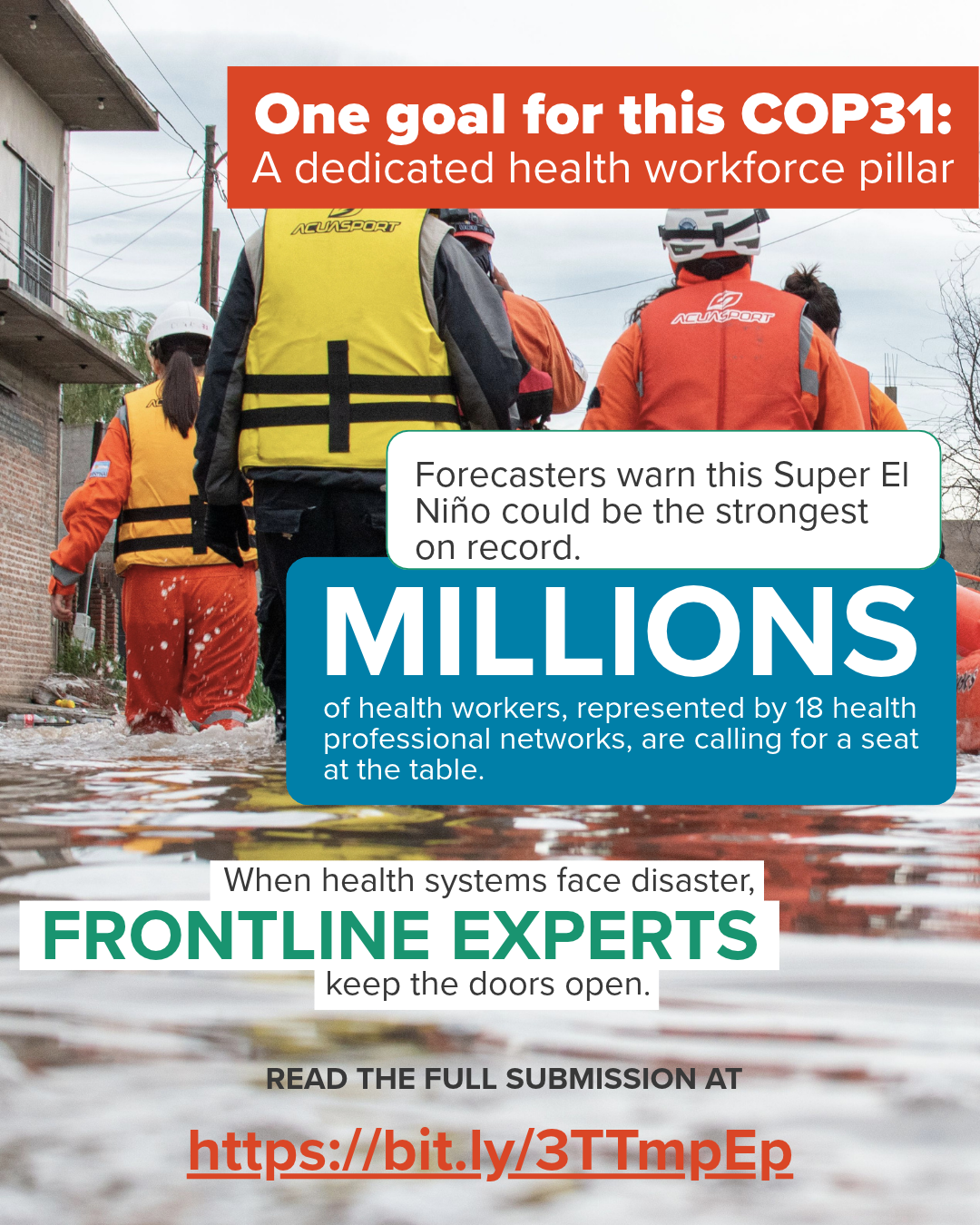
WONCA has joined health professional networks from around the world in a joint submission to the COP31 Presidency, led by Health Care Without Harm. It calls for a dedicated health workforce pillar within the Antalya Initiative for Resilient Health Systems (AIR), the Presidency's main health initiative, starting from the principle that there can be no resilient health system without a resilient, prepared and empowered health workforce.
The submission proposes:
- national health professional networks linked to AIR, building on existing networks rather than creating parallel ones
- climate and health competencies across the professional lifecycle, from undergraduate education to continuing professional development
- a formal role for health professionals in national climate, health adaptation and emergency preparedness plans
- protection of the health, safety and wellbeing of health workers during climate-related emergencies
- support for health professionals to discuss climate-related risks and solutions with their communities
- investment in country-level research on vulnerabilities, adaptation needs and effective interventions
The submission has been formally delivered to the COP31 Presidency and Türkiye's Ministry of Health. The signatories have offered to work with the Presidency on a consultation with health professional networks, a framework for the workforce dimension of AIR, country case studies and health professional representation during Health Day.
What is COP?
COP stands for Conference of the Parties. It is the annual meeting of the countries that are party to the United Nations Framework Convention on Climate Change (UNFCCC), where governments negotiate and review global action on climate change. Nearly 200 countries take part, alongside civil society, scientists, businesses and health organizations.
COP31 takes place at the Antalya Expo Center from 9 to 20 November 2026. For the first time, the presidency is shared: Türkiye is hosting the conference and leading its Action Agenda, while Australia presides over the negotiations.
Türkiye has made resilient health systems a priority of its COP31 Action Agenda, the first time health has been formally included on a COP action agenda, and the conference opens with Health Day on 9 November. Through AIR, the Presidency aims to strengthen how health systems prepare for, respond to and adapt to climate-related health risks, and to give countries a platform for sharing experience and practical solutions.
Why primary care matters
Family doctors see the health effects of climate change in their daily work, from patients struggling through heatwaves to practices trying to keep care going during floods and power cuts. They know their communities, and they are well placed to identify the patients most at risk and to help turn national plans into local care.
The call for health professionals to be involved in preparedness planning also reflects WONCA's advocacy at the World Health Organization. At the WHO Executive Board, WONCA has urged that family doctors be formally included in emergency preparedness and response decision-making.
WONCA's work on planetary health

The WONCA Working Party on Planetary Health brings together family doctors working on the links between the environment and health. It began as a Special Interest Group on the Environment in 2007, became a Working Party in 2011 and took its current name in 2023. Its vision is healthy people, healthy communities and healthy ecosystems on a healthy planet, an idea that sits close to the One Health approach.
WONCA statements and declarations on climate and health include:
Family doctors and students interested in planetary health are welcome to join the Working Party on Planetary Health or to contact it at planetaryhealth@wonca.com.
Find out more