WONCA Digital Health Webinar Series: Session 2
WONCA Digital Health Webinar Series: Session 2
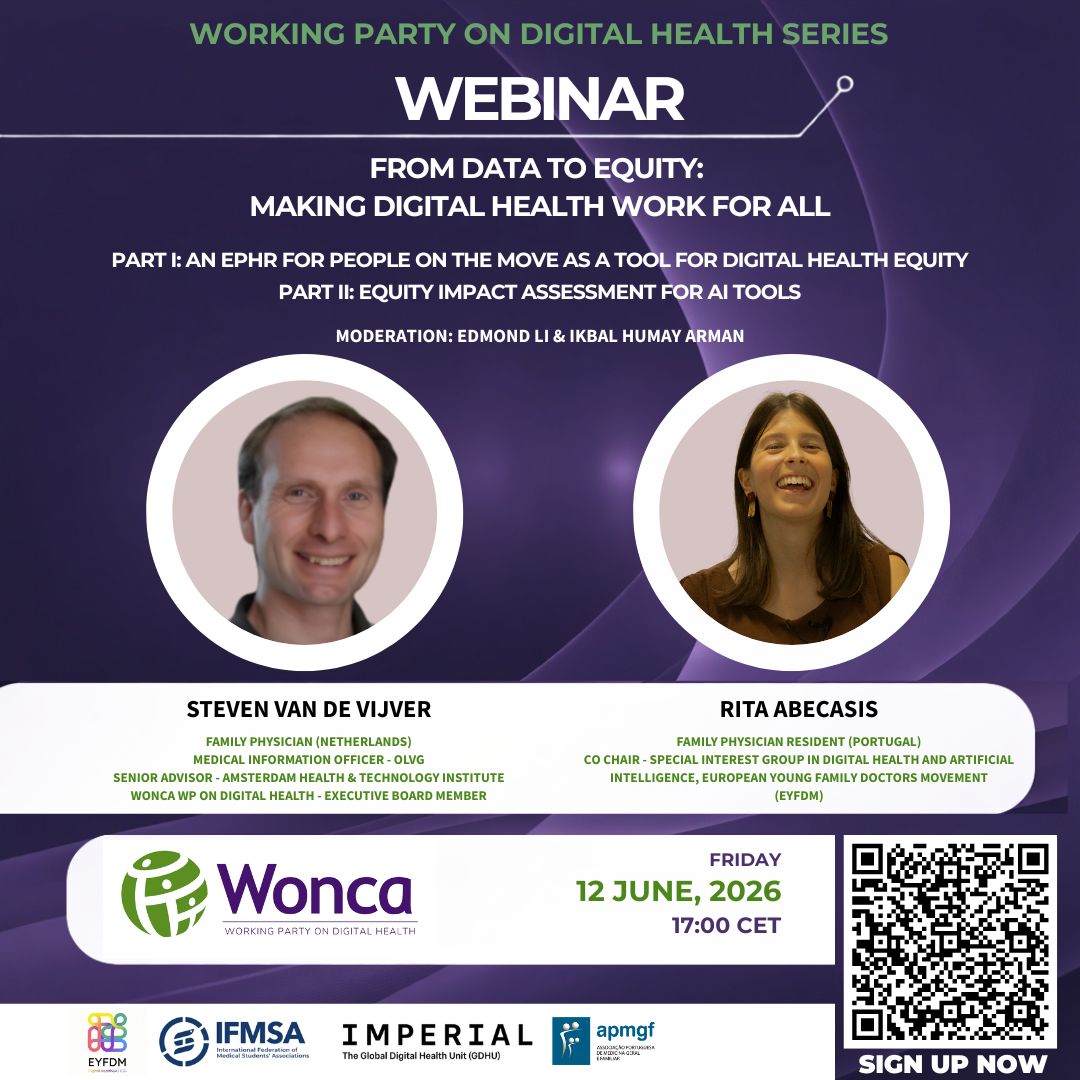
How can digital health support equity in primary care while ensuring vulnerable populations are not left behind?
Join Session 2 of the WONCA Digital Health Webinar Series, an international initiative led by the WONCA Working Party on Digital Health to support family doctors and primary care teams in understanding and integrating digital health into everyday clinical practice.
This webinar is co-created in collaboration with the Special Interest Group in Digital Health and Artificial Intelligence of the European Young Family Doctors Movement.
The session will explore two important topics at the intersection of digital innovation and health equity.
Part I: An EPHR (Electronic Personal Health Record) for people on the move as a tool for Digital Health Equity
Speaker: Steven van de Vijver
This talk will explore how Electronic Personal Health Records can improve continuity of care for migrants, refugees, and mobile populations whose healthcare information is often fragmented across systems and borders. Using HealthEmove as a real-world example, the session will discuss how digital tools can support communication, accessibility, and continuity of care while addressing challenges such as trust, privacy, interoperability, and digital exclusion.
Part II: Equity impact assessment for AI tools
Speaker: Rita Abecasis
This session will examine why artificial intelligence in healthcare must be assessed through an equity lens before and during implementation. Topics will include biased data, opaque decision-making, unequal impacts on underserved populations, and practical approaches to evaluating and mitigating these risks through governance models and equity assessment frameworks.
Date: Friday, 12 June 2026
Time: 17:00 CET
Register here: WONCA Digital Health Webinar Series: Session 2
Together, we hope to create a meaningful international exchange on how digital innovation can strengthen primary care while remaining equitable, ethical, and people-centred.
Speakers
Steven van de Vijver is working as a family doctor and Medical Information Officer at the OLVG hospital in Amsterdam, The Netherlands. In addition, he works as a Senior Advisor at the Amsterdam Health & Technology Institute, where he is guiding several innovative projects in the field of digital health and primary care, including HealthEmove.
In the past, he worked for Amsterdam Institute of Global Health and Development and received his PhD during his three-year stay at the African Population and Health Research Center on the design, implementation and evaluation of cardiovascular prevention for the urban poor in Nairobi, Kenya.
Currently, his specific interest as a medical doctor and researcher is to increase universal health coverage through digital health. In what way can digital innovations diminish instead of increase the existing growing inequality in health? One example is an Electronic Patient Health Record for refugees, migrants and other people on the move.
In addition, as a writer he has published several books and more than 40 scientific articles.
Rita Abecasis is a Family Medicine resident at USF da Baixa in Lisbon. She earned her medical degree from NOVA Medical School in 2021 and pursued a postgraduate degree in Information Management and Business Intelligence in Healthcare.
She is Co-Chair of the Special Interest Group in Digital Health and Artificial Intelligence at the European Young Family Doctors Movement and a board member of the Digital Health Group of the Portuguese Association of General Practice and Family Medicine.
Her work focuses on AI in primary care, especially how to ensure fair access to digital tools and opportunities. She also works in social prescribing and leads community health projects supporting migrant inclusion, which has deepened her commitment to health equity and access to care.
Watch the first webinar
The first webinar in the WONCA Digital Health Webinar Series brought together colleagues from across the world to discuss compassionate, patient-centred care in a digital world.
Held on Tuesday, 12 May 2026, the session introduced the new international series of 10 sessions led by the WONCA Working Party on Digital Health, designed to support family doctors and primary care teams in understanding and integrating digital health into everyday clinical practice.
Through a structured programme of sessions, the series aims to share practical, evidence-based insights and foster global exchange on the evolving role of digital technologies in primary care.
The first webinar examined how digital innovation is affecting the quality of care in primary care settings, while highlighting the importance of ensuring that technology supports the human dimensions of care, including compassion, continuity and the patient-clinician relationship.
Part 1: Digital Health in Primary Care - Exploring Impact on Quality and Patient Care
Digital technologies are transforming the delivery of primary care. From online consultations and remote monitoring to artificial intelligence and decision-support tools, digital innovation has the potential to reshape patient care and service organisation. However, understanding how these technologies affect the quality of care remains a key challenge.
This introductory session set the scene for a series exploring digital innovation in primary care through the lens of the six domains of healthcare quality: patient-centredness, effectiveness, efficiency, timeliness, equity, and safety. It also introduced the themes of the upcoming sessions, which will examine how digital innovation can influence each domain and discuss related opportunities, risks, and real-world implementation experiences.
Speaker: Ana Luisa Neves
Part 2: Patient Centered Care - Keeping it human in the age of AI
Patient-centered care remains a cornerstone of high-quality primary care, emphasizing the need to understand patients as whole persons with unique feelings, ideas, and expectations.
In an era shaped by digital transformation and increasingly complex health systems, maintaining meaningful patient-clinician relationships is more important than ever.
This webinar explored the foundations of the Patient-Centered Clinical Method, including empathy, compassion, and sharing power in clinical encounters. It also discussed why patient-centered care matters for both patients and clinicians and how emerging technologies are reshaping care delivery.
Through real-world examples from primary care, the session offered insights into how family doctors can sustain trust, equity, and human connection in a technologically mediated world.
Speakers: Moira Stewart and Keith Thompson
Moderator: Hüsna Sarıca Çevik